SimuDice

Simulating Rolling Multi-Sided Dice

Daddy The Runner
Developing Data Products

Introduction to SimuDice

  • SimuDice allows you to explore the characteristics of rolling collections of dice

  • Description:

    • The purpose of this shiny app is to explore the probability distributions of rolling various combinations of multi-sided dice. The app allows the user to choose the set of dice to use for the simulation as well as the number of rolls to simulate.
  • Dice Basics

    • The most common/familiar die is a six-sided cube
    • Rolling a single die results in a simple uniform distribution
    • Rolling two dice (e.g. 2 x 6-sided dice) yields a simple triangular distribution
    • Dice can be made from any regular polyhedron
    • There are six regular polyhedrons with the following sides:
      • 4, 6, 8, 10, 12, 20

Rolling Multiple Dice

  • Rolling multiple dice results in a random sampling of numbers
  • These numbers can be combined (or aggregated) into a single statistic
    • The traditional statistic used is a simple summation:
      • Dice values: 4, 5, 2
      • sum: 11
    • Other options include:
      • max: 5
      • min: 2
      • range: 3
        • Where range is defined as max - min
    • These non-traditional aggregations produce some interesting and complex probability distributions

Sample SimuDice Plot

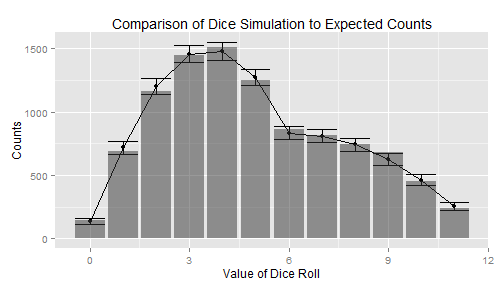
  • Here is a sample plot from SimuDice for a simulation of 10,000 rolls of three dice: 2 x 6-sided dice and 1 x 12-sided die using the range aggregator

plot of chunk unnamed-chunk-1

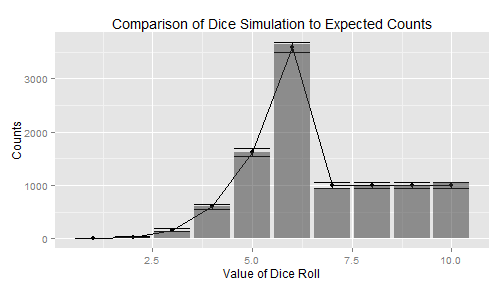
  • The bars show the total number of times each range value appeared in the simulation. The line, points and wiskers represent the expected simulation results and the 95% confidence range.

Sample SimuDice Plot

  • The following is a plot for a simulation of 10,000 rolls of 5 dice: 4 x 6-sided dice and 1 x 10-sided die using the max aggregator

plot of chunk unnamed-chunk-2